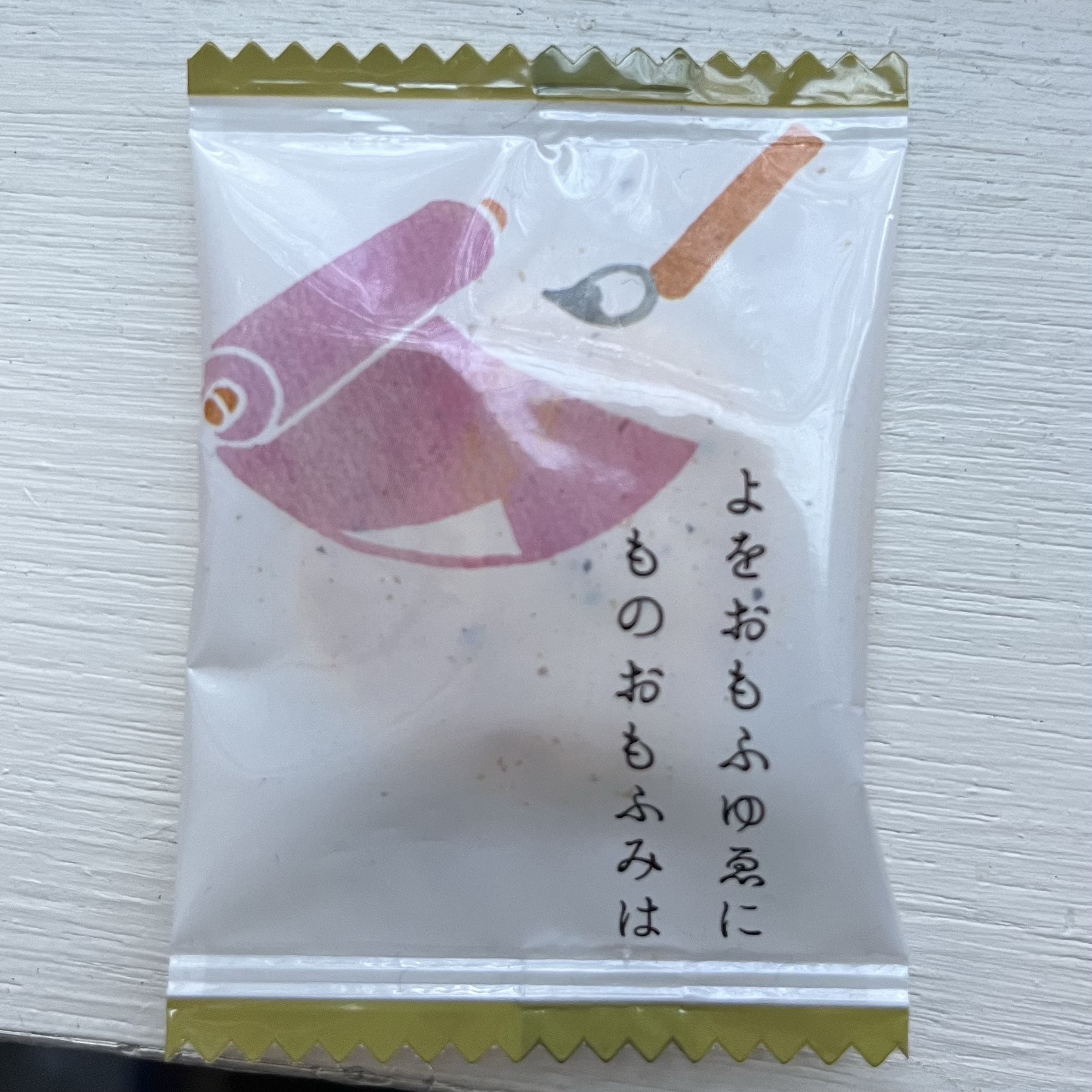
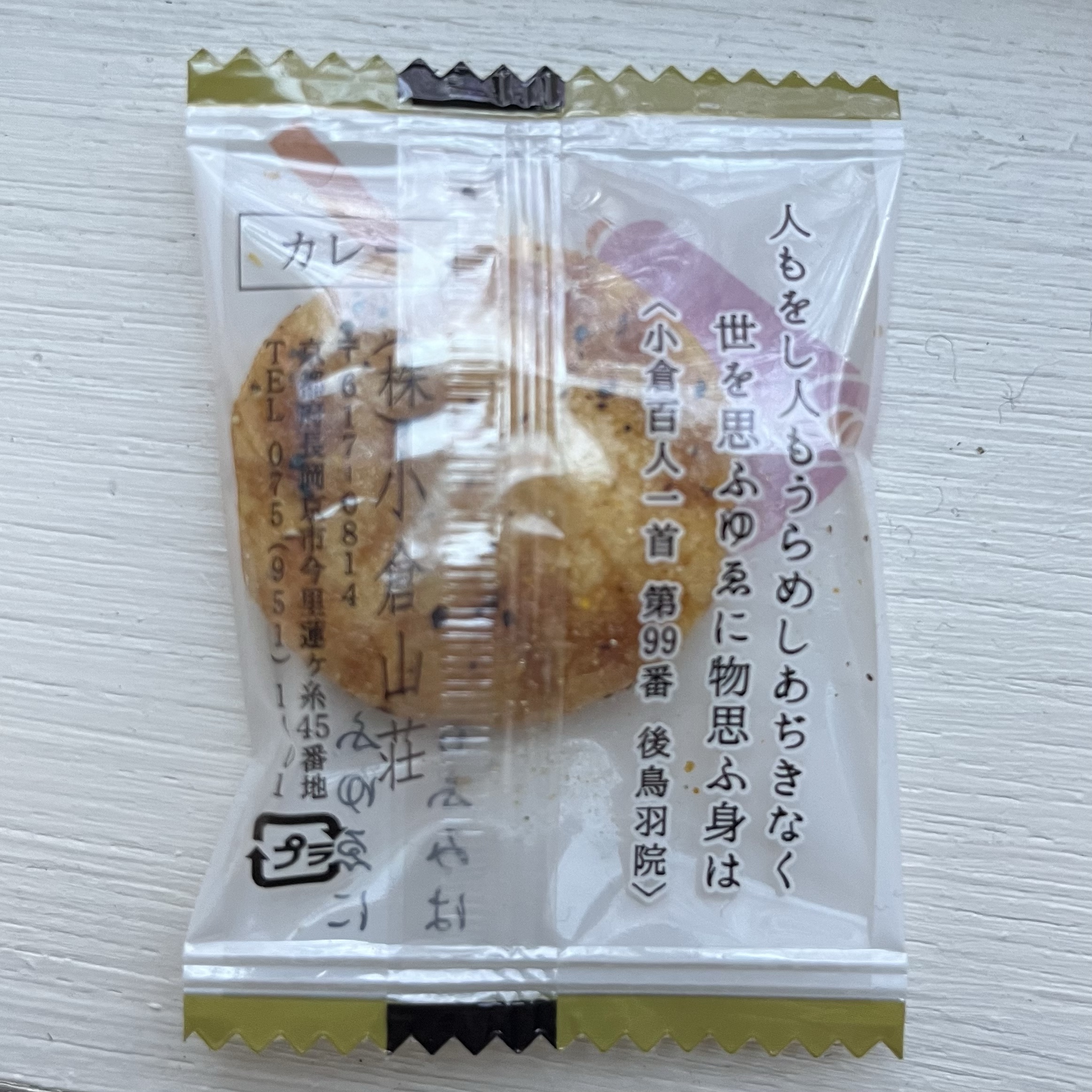
In Japan, gift-giving (omiyagé お土産) among friends and relatives is a common tradition, and recently a friend returned from Japan and gave us some special crackers (senbei) featuring poems from the Hyakunin Isshu. The crackers come in different flavors, and the wrapper each has a random poem.
I got a curry-flavored one:
The first two verses of the poem, poem 99, are written on the front. On the back are the remaining verses:
Hyakunin Isshu-themed crackers are sold here and there, and I’ve posted about it in the past, but it’s still nice to get them from time to time.
P.S. This vendor sells Hyakunin Isshu themed senbei crackers as well (it was the vendor featured in the original post).
This poem was composed by Supernumerary Middle Counselor Sada’ie (権中納言定家, 1162-1241), better known as Fujiwara no Teika, or alternatively Fujiwara no Sadaie.1 He is considered one of the greatest poets in all of Japanese history. Teika was the compiler of this Hyakunin Isshu anthology and was also one of the major compilers of the officialShin Kokin Wakashū anthology. He was also the tutor for Shokushi Naishinno (poem 89), and it is thought that they had a romantic relationship too, though eventually they would be separated for good. In any case, his talent and his family’s influence were so great that the family virtually monopolized the Court poetry for centuries to come. But we’ll talk more about that shortly.
Fujiwara no Teika composed many of his own poems in his lifetime, and yet in compiling the Hyakunin Isshu, why did he select this particular poem for inclusion?
Like many of the later poems in the anthology (poem 90, 91 and 94), this poem alludes to a much older one. In Teika’s case, his poem alludes all the way back to the original anthology in Japan, the Manyoshu. Unlike later anthologies, the Manyoshu was a loose connection of poems, compiled 400+ years before Teika, and the particular poem he alludes to was written from the perspective of a man whose love was burning for a woman like the boiling of seaweed at Matsuo Bay. As you can see, Teika reversed the perspective to be that of a woman, while still alluding to the original. Additionally, Teika gives his poem a sadder tone than the poem from the Manyoshu, which came to be a hallmark of Teika’s style.
Incidentally, Matsuo Bay (written as Matsuho 松帆 here) is on the very northern tip of the famous Awaji Island in the Inland Sea. It is a scenic part of Awaji Island, and even has its own homepage. Awaji Island is also the scene for poem 78. The technique of extracting salt by boiling seaweed, or moshio (藻塩) is a time-honored tradition in Japan, and the seaweed gives the salt a special flavor. There’s a really good article about it here.
Fujiwara no Teika was a master of expressing yūgen (幽玄) or subtle, profound beauty in his poetry. This kind of subtle beauty centuries later came to influence other arts in time in Japan including Noh theater, tea-ceremony, etc.
But who was Fujiwara no Teika?
Teika, alternatively read as Sada’ie, was born from an illustrious family of poets though a minor branch of the powerful Fujiwara clan. His grandfather was Fujiwara no Toshitada and his father was Shunzei (poem 83). As a youth, Teika was a sickly boy but as the eldest son, he was obligated to carry on the family legacy. Unfortunately due to complex court politics, Teika was overlooked for much of his early life. However after a fortunate turn of events, he was noticed by Emperor Go-Toba (poem 99) who eventually commissioned him to compile two new anthologies, including the Shin Kokin Wakashū.
Over time though, Teika and Emperor Gotoba disagreed over poetry and compiling the anthology, leading to an increasingly distant and cold relationship. Teika found Gotoba overbearing, while Gotoba didn’t care for Teika’s free-wheeling style. At times, Teika and Gotoba openly criticized one another through poetry, or in their diary entries, and Gotoba even banished Teika for a year from the capitol. Teika meanwhile grew closer to Gotoba’s son who later became Emperor Juntoku (poem 100), while Gotoba became increasingly occupied with the martial arts, and with wresting power back from the samurai rulers in Kamakura (cf. poem 93)
Unfortunately for Emperor Gotoba, his meager forces were utterly routed by the Kamakura army in the short-lived Jōkyū War, and Gotoba was sent into exile (since it was sacrilege to kill the Emperor). Teika was not involved in the war, so he remained in Kyoto, and even reached the Imperial post of Middle Counselor. During this time, he also completed another Imperial anthology, the Shin Chokusen Wakashū, which shows more of his down-to-earth later style.
Finally though, his health declined from old age and from the famine at the time, so he retired and took Buddhist tonsure. It was during his final years in a Buddhist monastery that he was invited by his son’s father-in-law, Lord Utsunomiya no Yoritsuna, to his villa at Mount Ogura near Kyoto.
This stone marker at Jojakko-ji Temple in west Kyoto, near Arashiyama, marks where Teika had compiled the Hyakunin Isshu. More on that in this post. Photo taken in August 2024.
Lord Utsunomiya asked Teika to compile 100 poems in his own hand, so that they could be adorned on the silk screens of his villa, and these 100 eventually became the collection that we know today.
After Teika died at the age of 80, he was interred at Shokoku-ji Temple in Kyoto. The featured photo above shows his grave marker (Photo courtesy of Wikimedia Commons.). His grandchildren formed into three rival schools of Waka poetry that dominated the poetry scene for centuries:
Nijō School (nijō-ha 二条派) – the conservative and dominant school at first. Over time, a series of misfortunes eventually caused the school to decline and fade by the medieval period in Japanese history.
Reizei School (reizei-ke 冷泉家) – the more liberal branch, but a few generations later became the dominant branch. By the middle of the Muromachi Period, two branches had formed: the upper Reizei school (kamireizei 上冷泉家) and the lower Reizei school (shimoreizei 下冷泉家), which the upper school prevailing in the long-run. This school still maintains a large compound in Kyoto to this day.
Kyōgoku School (kyōgoku-ha 京極派) – this school died out in only a couple generations.
But more importantly, the legacy of Fujiwara no Teika is in his celebrated poetry anthologies, particularly this one. Even today, many kids in Japan enjoy playinguta-garuta in school competitions, and there are even Japanese anime about the Hyakunin Isshu. All of this is due to Teika’s talent and taste for selecting good poetry.
And now, this anthology is enjoyed by international readers like yourself. This blog was a originally a little experiment of mine, but I have enjoyed your readership, your comments, and of course your support. Thank you everyone from the bottom of my heart.
As this is the 100th and final poem of the Hyakunin Isshu, that is all I have to offer on this blog. I may take it up again sometime in the future and cover other anthologies like the Kokinshu and the Shinkokinshu, but for now, I decided that I prefer to leave it as it is.
1 The Chinese characters (kanji) for his given name (定家) have multiple readings possible, and both are seemingly correct. However, based on a cursory glance in Japanese, it seems that “Teika” is the more common reading.
The author, Nyūdō Saki no Daijōdaijin (入道前太政大臣, 1171 – 1244), or “Buddhist novice and former Chancellor of the Realm”. His personal name was Fujiwara no Kintsune. He was a powerful member of the elite Fujiwara clan and extended his support to the Hyakunin Isshu’s compiler, Fujiwara no Teika (poem 97), after Teika married Kintsune’s older sister. He was also well-liked by members of the old Imperial Court and the new military government at Kamakura.
According to Mostow, Kintsune married a niece of Minamoto no Yoritomo, the first shogun of the new military government. After Yoritomo’s son Sanetomo (poem 93) died a tragic death with no heir, Kintsune pushed to make his grandson Kujō Yoritsune, a distant relation to Sanetomo, the next shogun. My new book states that his reputation worsens in his later years as he kept manipulating the power of shoguns from behind the throne.
It also implies that Kintsune may have helped tip off the new military government about Emperor Gotoba’s (poem 99) plans to wrest back control, helping to contribute to the demise of the Emperor and his son (poem 100).
Ah, times had changed since the earlier generations of the Hyakunin Isshu mostly worried about poetry contests and marriage arrangements.
But I digress.
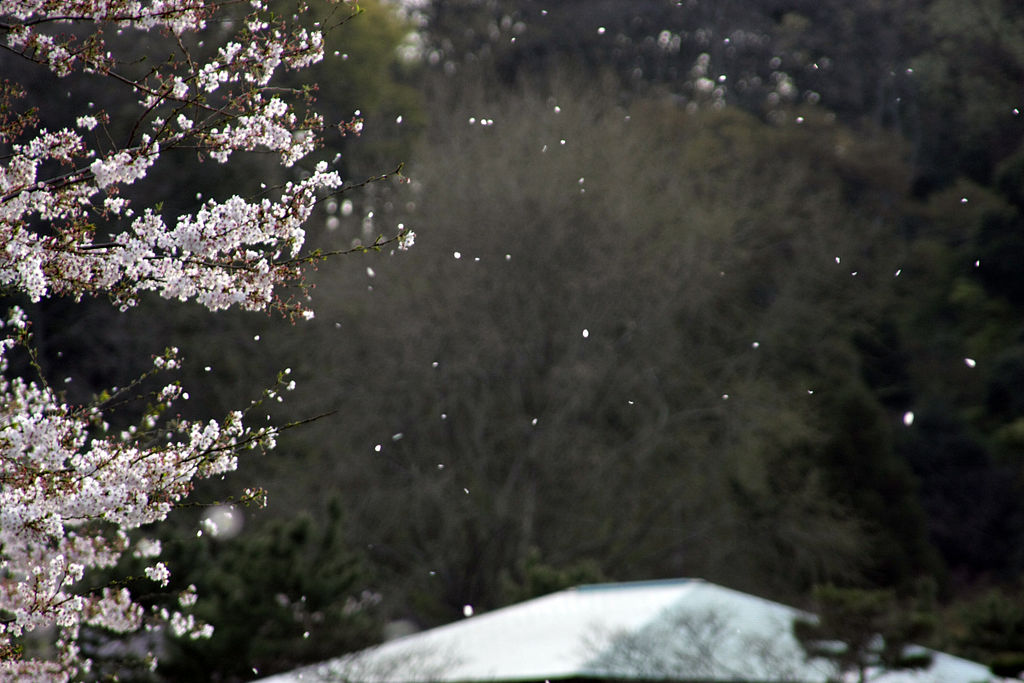
This poem, unlike other poems recently posted which were more clear-cut in meaning, often was the subject of much interpretation. The contrast between the aging man and the scattering of flowers in the wind, called hana fubuki (花吹雪) led to many interpretations by later commentators particularly about the man growing old, according to Professor Mostow. Perhaps he won’t be back next year?
The image of hana fubuki also is noteworthy, because it isn’t a small scattering of flowers. It refers to great scattering of blossoms in the wind, just like a snowfall. Thus Kintsune is witnessing this great scattering even as he contemplates his own decline even after so many years in power.
Pretty awesome poem, really, for a man who lived a noteworthy life.
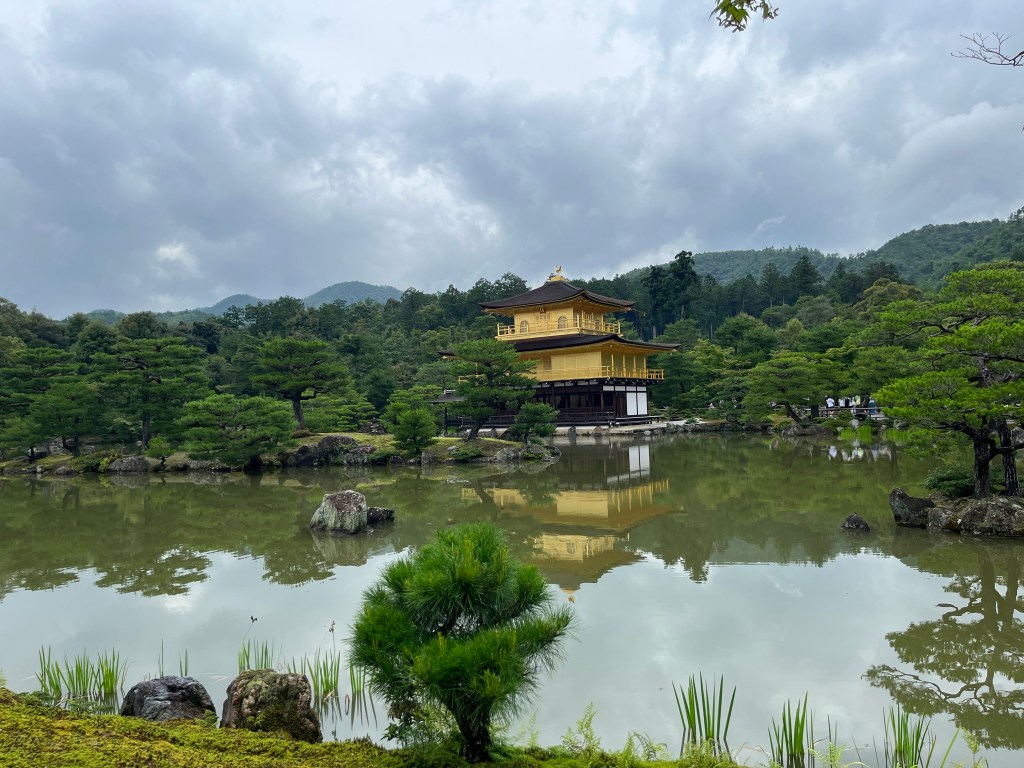
Speaking of scenic views, Kintsune’s residence of Saionji (西園寺), which was also established as his clan’s new name (Saionji), later became the famous Golden Pavilion.
Taken by me in July 2023
Indeed Kintsune’s contribution to Japanese culture and history, dubious as it may be, can be felt even today.
The author, Sangi Masatsune (参議雅経, “Counselor Masatsune”, 1170-1221), also as known as Fujiwara no Masatsune, was another editor of the Shin Kokin Wakashū like Yoshitsune (poem 91) and went on to found the poetic house of Asukai (also famous for calligraphy). He also studied under Shunzei (poem 83) earlier in his career.
I had to look up what fulling cloth meant, but apparently it’s the process of beating cloth, especially wool, to improve the texture, or in the case of Japan, give the cloth a nice glossy sheen. You can see an example of this above, in a painting made in the 1800’s, almost 700 years later. I can’t imagine the process changed much within that time. The process was to place the cloth on a wood or stone surface and pound it with a wooden mallet. In Japanese, the process called koromo utsu (衣打つ) just as it is mentioned in this poem.
Also, this poem, like other poems we’ve looked at recently (poem 90 and poem 91), alludes to a much older poem by Korenori (poem 31), which also mentions snow in the village of Yoshino (yoshino-chō, 吉野町), near the old capitol of Nara.
Interestingly, the “former capitol” is referred to by the poetic phrase furusato, which in modern Japanese means one’s hometown. Nara was the capitol of Japan during the early Nara Period, and personally my most favorite place to visit in Japan. The culture at that time was an interesting fusion of early Japanese culture, Chinese art and culture, and Indian Buddhism (via Silk Road). Even after the capitol was moved to Kyoto (another great place), there existed many euphemisms to the “former capitol” by later poets and authors (poem 61, for example) as a kind of nostalgia or the “good ol’ days”. Hence the use of the term furusato I believe.
P.S. Featured photo is Surimono, Woman Fulling Cloth in the Moonlight, by Shigenobu, Brooklyn Museum, No restrictions, via Wikimedia Commons
The author of this poem is Nijōin no Sanuki (二条院讃岐, 1141 – 1217), also known as “Lady Sanuki of Nijōin”. Her real name isn’t known. It is known that she was a daughter of famous warrior/poet Minamoto no Yorimasa and served the retired Emperor Nijō, hence her name nijōin (Imperial House of Nijō). The “Sanuki” part comes from Sanuki Province where her father was once posted on assignment.
Sanuki, like Sokushi, was a leading female poet of her day, and this poem helps illustrate why. As we discussed recently in poem 90, the image of sleeves wet with tears was a popular poetic technique used at the time for unrequited love (again, see poems 42, 65, and 72) but the idea of such sleeves being hidden like a submerged rock offshore was a novel, new way of expressing this.
Indeed, Sanuki became so famous for this verse, she herself was often referred to as oki no ishi no Sanuki (沖の石の讃岐) by later poets and authors. It was pretty rare for a poet to receive such a name for a famous verse they composed but a few other examples exist. Another female poet named kunaikyō (宮内卿) was called wakakusa no kunaikyō (若草の宮内卿) because of a famous verse she wrote regarding young grass (wakakusa, 若草) from the Shin Kokin Wakashū:
Japanese
Romanization
Translation
薄く濃き
Usuku koki
Light and dark:
野辺のみどりの
Nobe no midori no
the green of the field’s
若草の
Wakakusa no
young herbs
あとまで見ゆる
Ato made miyuru
distinct in
雪のむら消え
Yuki no muragie
patches of fading snow.
Translation source unknown
Pretty awesome when you can make a name for yourself that way.
This sad, miserable poem was ironically composed by a famous poet of his era named Gokyōgoku Sesshō Saki no Daijōdaijin (後京極摂政前太政大臣, 1169-1206) or ”The Gokyōboku Regent and Former Chancellor”, also known as Fujiwara no Yoshitsune. He was the grandfather was Jien (poem 95). He was another member of the elite poetry family, the Mikohidari (see Jakuren poem 87) and was very well-represented in the Shin Kokin Wakashū poetry anthology which he was an editor. Elsewhere, as a scion of the Fujiwara family, he served as regent to the young Emperor Tsuchimikado, but unexpectedly died at the age of 36.
Astute readers may have noticed that this poem sounds similar, especially in Japanese, to a very early poem in the anthology by Hitomaro (poem 3). Even the last line is the same.
But part of the poem also seems similar to another poem in the Shin Kokin Wakashū anthology according to Professor Mostow, which relates to cold reed-mats and waiting alone. So, in a sense, this poem blends two famous poems and adds the novelty of crickets (kirigirisu) which symbolize autumn.
But as we’ve seen with poem 90, it was an accepted practice at the time to write poetry which allude to older poems in the poems. Indeed, as the author of the blog, I admit I kind of enjoyed this poem more when I noticed the final line and realized I had heard it before. So, I guess the amusement is not limited to 11th century Japanese aristocrats. 😉
Yoshitsune certainly never had to spend a night in the cold as a member of the elite Fujiwara family, but his ability to weave old poetry verses together and paint such a sad picture help explain why he was such a famous poet.
The author of this poem is Inpumon-in no Taiyu (殷富門院大輔, dates unknown) or “Taiyu of the Household of Princess Ryōshi”. She served Princess Ryōshi (“Inpumon-in”), the daughter of Emperor Go-Shirakawa. Princess Ryōshi was also known as Inpumon-in (殷富門院) hence the name here. Taiyu was an accomplished poet and another member of the elite “Garden in the Poetic Forest” group (see poem 85).
The poem here, according to Mostow, is a 200-year old rebuttal of an earlier poem that celebrates the “wet sleeves” of the fisherman of Matsushima, but saying “if you think their sleeves are wet, mine are even more wet and stained with blood-red tears!” We’ve seen other “sleeves wet with tears” poems in the Hyakunin Isshu, namely poem 65, poem 72, and my favorite poem 42. But Taiyu takes this one to a new level, I think. 🙂
Regarding the location, “Male Island” (雄島, Oshima in Japanese) is one of 200+ tiny islands in a famous island chain called Matsushima (松島) in modern-day Miyagi Prefecture. The featured photo above is Matsushima (photo by Chensiyuan, CC BY-SA 4.0, via Wikimedia Commons). The islands are all pretty small, and very scenic, and each has their own unique name. However, in the 2011 Great Tohoku Earthquake, the area was badly devastated and still recovering.
In any case, poets from antiquity and centuries later used Matsushima in their poetry and it’s easy to see why.
One other point worth mentioning is that this poem, and poem 89 use a clever trick in Japanese poetry called kugire (句切れ). The idea is to add a single syllable in there, usually on the first line, in order to add impact, but also as a filler to help maintain the standard 5-7-5-7-7 lines in Waka poetry. In this poem the kugire is on the first line, at the end: 見せばやな (mi-se-ba-ya-na), while in poem 89 it is 玉の緒よ (ta-ma-no-o-yo).
You can see this technique centuries later in Japanese haiku, such as in the famous poem by Basho in the year 1686:
Japanese
Romanization
Translation
古池や
Furu ike ya
An ancient pond!
蛙飛びこむ
Kawazu tobikomu
A frog jumps in;
水の音
Mizu no oto
the splash of water…
My amateur translation…
This haiku was composed 500+ years after the poems of the Hyakunin Isshu, but it’s interesting how some poetic-devices never quite get old.
This poem was composed by Lady Bettō (dates unknown), known in the Anthology as Kōkamon’in no Bettō (皇嘉門院別当). Lady Bettō served in the house of Empress Seishi, wife of Emperor Sutoku (poem 77). Lady Bettō was also the daughter of Minamoto no Yoshitaka.
Although the life of Lady Bettō is relatively unknown, and she doesn’t appear in many anthologies, Professor Mostow points out that her poem is quite a technical feat. There are not one, but three “pivot words”, or words that carry multiple meanings, and lend multiple interpretations to the poem:
karine can mean cutting a root (刈り根) or a brief nap (仮寝) such as when traveling.
hitoyo can mean either a single segment of a reed (一節) or a single night (一夜).
mi wo tsukushi can mean either to exhaust one’s body (身を尽くし) or one of the famous barriers in Osaka Bay (澪標, see also poem 20)
The poem itself uses many familiar themes too. We’ve seen a lot of poems that feature Osaka Bay, called Naniwa in ancient times, including poem 20, poem 19 and poem 72 among others. Similarly, we see references to reeds, just as we do in poem 39 and poem 19 (again).
What makes this poem stand out is the excellent use of word-play throughout. On the surface, it looks like just another love poem, but Lady Bettō knew what she was doing. 😌
P.S. Featured photo is of reeds (species Phragmites) in Amsterdam, photo by PersianDutchNetwork, CC BY-SA 3.0, via Wikimedia Commons
This poem was composed by Jakuren Hōshi (寂蓮法師, 1139 – 1202), “Dharma-master Jakuren”, whose name was originally Fujiwara no Sadanaga before he took tonsure. He is a nephew of Shunzei (poem 83) and according to Professor Mostow a leading poets in the house of Mikohidari. He helped to compile the official poetry anthologies at the time, but died before completion.
Professor Mostow points out that Fujiwara no Teika (poem 97), his cousin and fellow member of the House of Mikohidari, didn’t praise this poem at first, and it made the “cutting floor” of the Imperial anthology that Jakuren helped compile, the Shin-Kokinshū, or in other anthologies. And yet, years later, it appears here in the Hyakunin Isshu by Fujiwara no Teika. The poem is generally viewed as a simple, straightforward descriptive poem, which is perhaps why it wasn’t as highly revered as other more subtle poems, or poems with more of a backstory.
Still, I think anyone can appreciate the scenery painted in this poem even today.
Interestingly, the poetic verse kiri tachinoboru (霧立ち上る) or “the mist is already rising”, was coined by Jakuren and was associated with him by later poets and commentators.
P.S. I’ve been away from the blog for a couple months raising our new little boy and keeping up with holidays. Now that things are finally quieting down, I hope to complete the final 7 poems (aside from this one). I’m still debating on further topics for this blog, and suggestions or requests are always appreciated.
The author is a Buddhist monk named Shun’e Hōshi (俊恵法師, 1113 – ?), or “Dharma Master Shun’e” who was the son of Minamoto no Toshiyori (poem 74) and grandson of Minamoto no Tsunenobu (poem 71). Though he had taken tonsure, Shun’e was quite a social figure and gathered many poets and writers around him and his residence called the Karin’en (歌林苑, “Garden in the Poetic Woods”). According to Professor Mostow, one of his students was a famous writer named Kamo no Chōmei who wrote the “Account of a Ten Foot Hut” or Hōjōki.
This poem is another example of when a poem expressing a woman’s anguish is written by a man, presumably on a set topic for a poetry contest. Other examples include poem 18 and poem 21. Obviously being able to express a woman’s feelings, namely that of a jilted lover, so well from a male author was not an easy task, and was a mark of excellent poetic skill, and not surprisingly Shun’e is counted among the Later Six Immortals of Poetry.
The respect that male actors in later Kabuki theater who specialize in female roles earn probably has a similar origin.
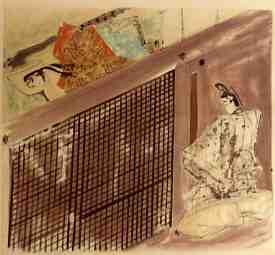
P.S. Featured photo is a scene from the illustrated Murasaki Shikibu Nikki Emaki, Public domain, via Wikimedia Commons