The poet Ise (伊勢, c. 875- c. 938), or “Lady Ise” in English, is another celebrated female poet from antiquity. Her sobriquet comes from her father’s position as governor of the prosperous Ise Province, but she earned a name for herself through her extensive poetry both in her private collection, the Ise Shū, and through Imperial anthologies where her poetry is both frequent and prominent.
As Professor Mostow explains, the poem has two possible interpretations: one where she has been spurned by a cold lover, and the other where she cannot reveal her hidden love.
Naniwa Inlet is the bay of what is now the famous city of Osaka, though back then it was a far smaller city, with many waterways, streams and such. Naniwa (Osaka) is often associated with reeds at the time as other poems of the time show, and is mentioned in two other poems in the Hyakunin Isshu (poem 20 and poem 88).
Although I have been posting love poetry from the Hyakunin Isshu all week in celebration of Valentine’s Day, I felt like posting this poem for all those who don’t like Valentine’s Day, or had a lousy time:
The author, Middle Counselor Asatada (中納言朝忠, 910 – 966), also known as Fujiwara no Asatada, was the fifth son of Fujiwara no Sadataka (poem 25) and one of the Thirty-Six Immortals of Poetry. I happen to consider this one of my favorite poems in the entire anthology, so I think it’s a fair ranking. 🙂
According to commentators, this poem was part of the same poetry contest as poems 40 and 41 and implies frustration that a woman has not consented to a visit by her presumed lover. Life would have been easier if they simply hadn’t bothered to try and meet.
However, Mostow also points out that the interpretation by Fujiwara no Teika (poem 97, who compiled the Hyakunin Isshu), was different, and implied that they had met, and she wouldn’t meet him again. It didn’t end well, in other words, and the lover is bitter over it.
P.S. Featured photo is a woodblock print of the Tale of Genji by Toyokuni Utagawa, Utagawa Kunisada, Public domain, via Wikimedia Commons
Fujiwara no Sanekata Ason (藤原実方), the poem’s author, was the grandson of Fujiwara no Tadahira (poem 26). True to his heritage, Sanetaka had an impressive record as a poet as well, and his poetry was frequently included in official anthologies such as the Shūishū among others. He was thought to also be friends with Sei Shonagon (poem 62) and Fujiwara no Michinobu (poem 52).
Sanekata apparently was quite full of himself too, and he later paid for this. According to my new book, Sanekata was a darling in his youth and frequently socialized with Emperors Enyu and Kazan. According to one story, when the Imperial procession went flower-viewing, Sanekata accompanied them, but then a heavy rain started. Everyone started to scatter, but Sanekata supposedly said “if I am going to get wet, might as well do it under the blossoms”, and he thus stood under a flowering tree. One Fujiwara no Yukinari later commented “that’s fine in poetry, but Sanetaka is a fool”. Sanetaka and Yukinari apparently had a prolonged and bitter hatred of one another, and in one incident Sanetaka took Yukinari’s headdress and angrily threw it into the garden. Emperor Ichijo, who caught sight of this, rebuked Sanetaka’s crass behavior, demoted him in rank, and sent him to the remote province of Mutsu as punishment. Yukinari, for his part, was later promoted head of the Imperial Archives.
According to Mostow, this poem was sent to a woman he was first starting to court, so the poem is an introduction of sorts to her, since she probably didn’t know who he was. The poem is as technically strong as it is bold, as Professor Mostow explains in detail. The reference to “Ibuki” is probably to a famous mountain in Japan called Mount Ibuki which has a variety of wildlife, including a kind of grass called sashimogusa or mogusa and is part of the Mugwort family. Mugwort was used in moxibustion, so it was burned, and this poem uses this as a symbol of his burning love.
According to Mostow, there is further word-play in the poem as sashimo can be read as sa shimo meaning “that much”, while the words mogusa and omohi reinforce each other to emphasize the passion of his burning love.
If Sanetaka wanted to introduce himself to a lady, he sure did a fine job of it!
The author of the poem was Sangi Hitoshi (参議等, 880-951, “Counselor Hitoshi”), also known as Minamoto no Hitoshi. According to Mostow, he held many provincial posts, but is lesser known in the poetry world. Apparently the poem was sent to a woman, and is a fine specimen of love poetry.
The poem, when read aloud in Japanese, has a nice sound to it, owing to the way that shinohara and shinobu repeat, but also the poem has a nice contrast to it. According to Professor Mostow, the fourth line reverses the idea of scarcity with talk of being overwhelmed by love creating a kind of balance in the poem.
One final note: the poem alludes to a couple plants of note:
one is chigaya (茅, Cogongrass, imperata cylindrica), which in the poem is called asajiu.
the other is a kind of thin bamboo grass called shinodaké (篠竹, pleioblastus simonii?), more commonly know as medaké in modern Japanese. The featured photo at the top of this post is an example of An example of pleioblastus simoni (photo by I, KENPEI, CC BY-SA 3.0, via Wikimedia Commons)
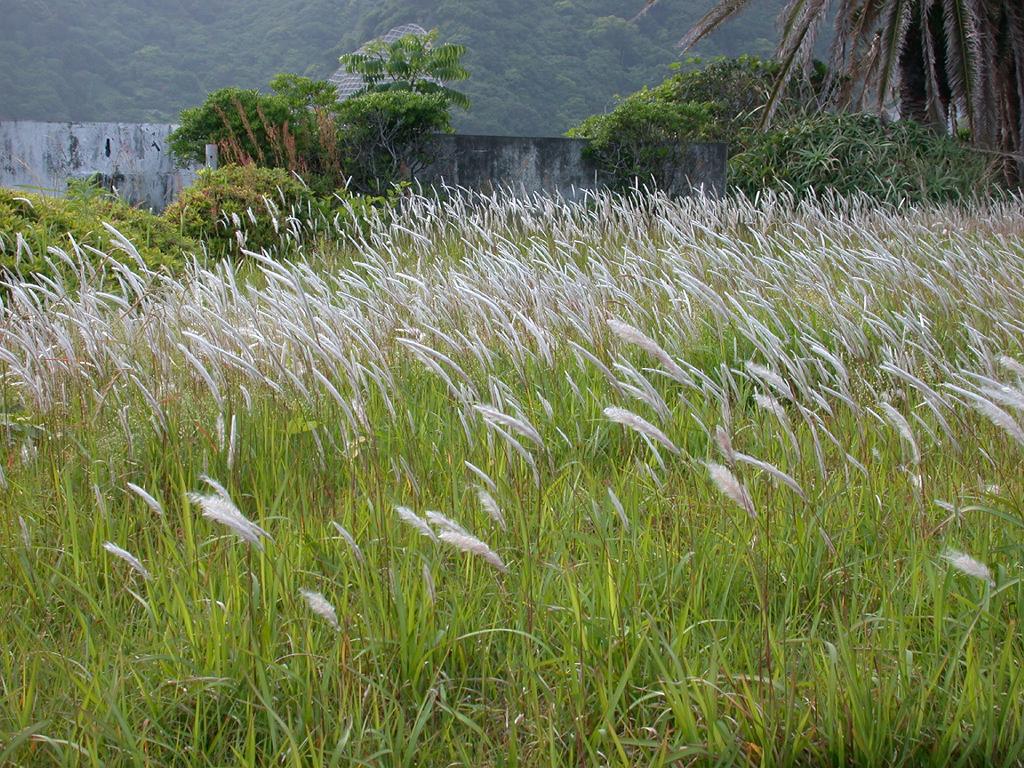
The scene described in the poem is a mixed field with taller bamboo grass poking out above a field of shorter reed grass.
The poem was composed by Sanjō Udaijin (三条右大臣, 873-932), or “Sanjō Minister of the Right”. He was also known as Fujiwara no Sadakata, the father of Fujiwara no Asatada (poem 44) and cousin of Kanesuke (poem 27). His sobriquet comes from his residence in the Sanjō district of the capitol of Kyoto (formerly Heian-kyō).
While successful politically, he was a minor poet in the day, whose poetry only appeared in a few collections. However, he was also the sponsor of a poetry circle centered around Kanesuke above, Ki no Tsurayuki (poem 35), and Ōshikōchi no Mitsune (poem 29) during the reign of Emperor Daigo.
Kadsura japonica (sanekazura), bearing fruit
In the days of the Heian Court, men and women frequently lived apart and meeting one another was very difficult. Also, traditionally, if they were going to meet, it was the man’s role to meet the woman. Thus poetry was a very useful means of expressing one’s love, arranging meetings, etc.
Here Sadakata uses the image of a vine pulling his lover to him (rather than him visiting her), but also a lot of clever word-play. The name of the place, Ōsaka (逢坂), no relation to the modern city, can mean “meeting place-hill”. Here, the verb for meeting, au/ou (逢う), is not the same as the generic, modern Japanese verb au (会う). The meeting in this context is an overtly romantic one. We see this again in Lady Izumi’s poem (poem 56). The name of the vine, sanekazura (Kadsura japonica), has the words sa ne (サ、寝), in there, meaning “come, sleep!” according to Professor Mostow. Lastly, the word kuru can mean either “come” or to “reel in”.
The poem was composed by Yōzei-in (陽成院, 868 – 949), known in English as Emperor Yōzei. Yozei was the firstborn son of Emperor Seiwa, and Empress Takaiko. Takaiko, is thought to have briefly eloped with Ariwara no Narihira, who wrote poem 17 (ちは) in the Hyakunin Isshu, as eluded to in episode six of the Ise Stories.
According to commentaries, the poem was intended for “the princess of Tsuridono” who was the daughter of Emperor Kōkō’s (poem 15, きみがためは).
Nevertheless, the analogy of Mount Tsukuba (modern-day Ibaraki Prefecture), pictured above, was an excellent choice. The mountain is famous in Japanese culture, especially for the two peaks: one called nantai (男体, “Man”) on the western side, and nyotai (女体, “Woman”) on the eastern side. It was a frequent topic used in love poetry back in the day. Even today, it is a very popular destination for tourists and nature lovers. This style of simple love poetry is something you’re likely to also see in older anthologies such as the Manyoshu or the Kojiki.
Sadly, Emperor Yozei is better known for his severe mental instability in later year. Anecdotes from the time relate how Yozei would commit odd or violent behavior, such as riding around the palace with his 30 horses, swinging around the legendary sword, Kusanagi, one of the Three Sacred Treasures of the Imperial Household, beating his wet nurse to death, and killing small animals for amusement. His behavior became increasingly erratic, and so he abdicated in favor of the aforementioned Emperor Koko in the year 884, at the age of 17.
….. or is that what really happened? My new book implies that there is a theory that the story of his insanity was made up by Koko’s faction, or possibly exaggerated as justification for a power-play. The fact that Yozei continued to live peacefully until the age of 82, composing poetry like the one above lends to the possibility that he was not as ill-health as first thought.
The author, Ōnakatomi no Yoshinobu Ason (大中臣能宣朝臣, 921 – 991), was the grandfather of Ise no Tayū (poem 61) and a prolific poet in his time, and one of the Thirty-Six Immortals of Poetry. According to Mostow, was also one of the “Five Gentlemen of the Pear Chamber” (nashi tsubo no gonin 梨壺の五人), with the Pear Chamber referring to a special room within the Court ladies’ residence of the Imperial Palace, which in turn was named after a special pear tree within the Palace gardens in the Ladies’ Quarter. This implied a very high honor indeed for Yoshinobu who was a member of the Inner Court.
Interestingly, Mostow suggests that the poem was in fact not written by Yoshinobu, owing to the fact that it does not appear in Yoshinobu’s personal collection and is listed as “anonymous” in other collections.
A scene from the Genji Monogatari (Tales of Genji), Metropolitan Museum of Art, CC0, via Wikimedia Commons
With Valentine’s Day fast approaching, it seems appropriate to post some of the many love poems from the Hyakunin Isshu. So, starting tomorrow, I’ll post one poem a day until the 14th.
The Hyakunin Isshu has two very popular topics frequently used in poetry: love poems and seasonal poems. While seasonal poems have been frequently posted here, love poetry probably comprises the majority of poems in the anthology. There are many reasons for this:
Poetry was a very popular past time among the nobility of the Nara and Heian Court. Poetry contests were very common, and a skillful poem could earn highpraise among Court circles, and possible promotion. Poetry topics frequently included lurid subjects such as a jilted lover, broken promises, or secret love. Poems 40 and 41 are among the best examples in the anthology.
Courtship in the Nara and Heian periods frequently involved indirect exchanges between men and women. In fact, men and women rarely saw each other face to face even while flirting with each other. So, poetry was a very useful medium of expression. Some of the more brilliant poems were preserved and praised by later generations.
Confucian values, which were very popular even then, stressed the importance of cultivating one’s self through the arts. Naturally this included poetry. The martial culture that characterized medieval Japan and its samurai rulers had not taken hold at this period of time..
Anyhow, enjoy the next several poems, and feel free to use them on the ones you love. 🙂
The author of the poem, Dōin Hōshi (道因法師, 1090 – 1179?), or “Dharma Master Dōin”. He lived as Fujiwara no Atsuyori, and served under Emperor Sutoku (poem 77), but wasn’t particularly successful. Later in life, he took tonsure in 1172 and became a Buddhist priest. It’s not clear if this poem was written before or after he took up the religious life.
According to Mostow, it’s not clear if the poem is a real expression of pain or part of poetry contest. Unfortunately, none of the poetry collections of Dōin survive, though he frequented poetry contests since 1160. He became a member of a famous poetry group called the Karin-en (歌林苑), though, and spent much time around other influential poets of the day.
P.S. Featured photo is Il Triste Messaggio (“The Sad Message”), by Peter Fendi, Public domain, via Wikimedia Commons
As Mostow notes the author, Kiyohara no Motosuke (清原元輔, 908 – 990) was the grandson of Kiyohara no Fukayabu of poem 36 and also the father of Sei Shōnagon who authored the Pillow Book and poem 62. Motosuke is also one of the Thirty-six Immortals of Poetry.
Sue-no-matsu is an actual mountain in Japan in Miyagi Prefecture, called sue no matsuyama (末の松山). This same mountain is said to have been visited by the Haiku poet, Basho, in a later age. The term matsuyama here (松山) refers to pine-clad mountains, so the idea is that the mountain will never wash under the waves, and thus the lovers’ feelings for each other would never die.
The poem’s intent here, as stated by the author himself in writing, was not to express Motosuke’s feelings, but rather for a friend whose lover’s feelings seemed to have grown cold. We see another example of a poet writing on behalf of another in poem 59. Still it serves as a sobering reminder that passion might be wonderful at the time, but is fickle too.




 The Hyakunin Isshu



_MET_DT4763.jpg)
