Summer is Back: Poem Number 81

As spring turns into summer, I thought this poem seemed really appropriate and a great topic for discussion:

JapaneseRomanizationTranslation
ほととぎすHototogisuThe hototogisu:
鳴きつる方をNakitsuru kata wowhen I gaze out towards where
ながむればNagamurebahe was singing,
ただ有明のTada ariake noall that remains is the moon,
月ぞ残れるTsuki zo nokorerupale in the morning sky.
Translation by Dr Joshua Mostow

This poem was composed by Gotokudaiji no Sadaijin (後徳大寺左大臣, 1139 – 1191), the “Later Tokudaiji Minister of the Left Sanesada”. His personal name was Fujiwara no Sanesada, and he was the first cousin of Fujiwara no Teika (poem 97), as well as the nephew of Shunzei (poem 83). He left behind an extensive poetry collection as well as his personal diary.

According to Professor Mostow, the poem was composed on the topic of staying up all night, to hear one cry.

The hototogisu (ホトトギス), is called the “lesser cuckoo” in English, or, is Cuculus poliocephalus. The featured photo was taken by Kunming Institute of Botany. Sun Jiao (Interaccoonale), CC BY 4.0, via Wikimedia Commons.

The hototogisu in Japan is a famous bird known for its early summer call, and is thus an emblematic bird of the season. Compare with the plover in poem 78.

You can see a video of its call below:

According to the Hyakunin Isshu Daijiten, the hototogisu is an elusive bird. It flies from branch to branch often, so by the time you hear its distinctive call, it probably has flown elsewhere. Hence, they are easy to hear, but hard for birdwatchers to observe.

In any case, as Professor Mostow explains, the author is waiting all night to hear the first call of the hototogisu as the first sign of summer.

One other note is the term 有明 (ariake), which is one of many poetic terms for the moon. Specifically it means the moon that remains in the morning, after daybreak. This normally occurs on the 16th day of the lunar cycle according to the old Japanese calendar.

P.S. Like the title, I’m back too. 😉

Wishing This Moment Wouldn’t End: Poem Number 73

Cherry-blossom season doesn’t last long, so while there’s still time, I wanted to post one last poem on the subject:

JapaneseRomanizationTranslation
高砂のTakasago noAbove the lower slopes
の桜Onoe no sakuraof the high mountains,
the cherries
咲きにけりSaki ni kerihave blossomed!
とやまのかすみToyama no kasumiO, mist of the near mountains,
立たずもあらなTatazu mo arananhow I wish you would not rise!
Translation by Dr Joshua Mostow

The author, Gonchūnagon (権中納言匡房, 1041 – 1111) or “Supernumerary Middle Counselor Masafusa”, was a prolific poet both in Japanese and in Chinese-style, and was a close confidant of Emperor Horikawa after retirement. His personal name was Ōe no Masafusa. As Professor Mostow notes, the poem’s meaning is very clear from the headnote, so there’s little if any debate about its meaning (unlike many poems in the Hyakunin Isshu). Masafusa hopes that the mist will not rise and block the view of the blossoms.

This poem brings to mind a time-honored tradition in Japan called hanami (花見) or “cherry-blossom viewing”. 🌸 This is a tradition you can see alive and well in Japan today, and each year there are plenty of websites and helpful guides for Japanese and foreigners to find a good spot for viewing.

However, during the time of the Heian Court and the poets of the Hyakunin Isshu, it was more of an outing for elite members of the court only. Such excursions, just like now, included lots of music, singing and drinking as well as impromptu poetry. The only difference, really, was that back then it was a very isolated affair between good friends and a private spot, whereas now people really have to fight for a good spot in places like Tokyo or Kyoto, and often times involve one’s boss and associates from work. 😏

Still, while some things have changed, it’s nice to see such a tradition live on for so many generations.

P.S. Featured photo is of cherry blossom viewing (hanami) in Oyamazaki, Kyoto Prefecture, Japan. Photo by Oilstreet, CC BY-SA 3.0, via Wikimedia Commons

Cherry Blossoms in Unexpected Places: Poem Number 66

Now that Spring is finally here, and cherry blossoms are blooming in Japan, I thought this poem was especially fitting:

JapaneseRomanizationTranslation
もろともにMorotomo niLet us think of each
れと思Aware to omoeother fondly,
山桜Yama-zakuraO mountain cherries!
花より外にHana yori hoka niFor, outside of your blossoms,
知る人もなしShiru hito mo nashithere’s no one who
knows my feelings.
Translation by Dr Joshua Mostow

The poem was composed by Saki no Daisōjō Gyōson (前大僧正行尊, 1055 – 1135), or “Former Major Archbishop Gyōson”, who according to Mostow, was a famed yamabushi or mountain ascetic, who dwelt on Mount Ōmine near Nara for a long time. He was the great-grandson of Emperor Sanjo (poem 68), and also a very prolific author in his day.

At the age of 10, his father passed away, and by age 12, Gyōson took tonsure at the Buddhist temple of Mii-dera, a major temple of the powerful Tendai sect. According to one episode in my new book, Gyōson had a reputation for being an expert at supplication of the Buddhist deities (lit. kaijikitō 加持祈禱). According to one story, when the newborn baby of Emperor Toba suddenly stopped breathing. Gyōson beseeched the gods, and somehow saved the baby, gaining trust of the Imperial family.

As for the poem, Mostow comments that the poem itself is fairly straightforward, but the poem’s headnote has confused many scholars over time, stating that it was composed “when he saw cherry blossoms unexpectedly at Ōmine.” Was it the time of year, or the location that made it so unexpected? No one really knows for sure.

Also, the term yamazakura (山桜) refers to mountain cherry blossoms. This is a wild variety of cherry blossom that differs from the typical cherry blossoms (somei-yoshino) often seen in gardens. The blossoms are more whitish than pink in color, and bloom at the same time that the leaves do.

Mount Ōmine (大峰山) near Nara was, among places, a popular mountain retreat for yamabushi practitioners. The phrase morotomoni means “you and me”, and implies intimate familiarity.

But, the joy of seeing cherry blossoms at this time of year is hard to deny. 🙂

P.S. Featured photo shows mountain cherry blossoms in Gunma Prefecture, Japan, taken by mahlervv, CC BY 3.0, via Wikimedia Commons

Memories of the Old Capitol: Poem Number 61

Sorry for the lengthy hiatus everyone. Been a long couple of weeks, but I am excited to post this poem in honor of women poets this month, and timely because of the coming of spring:

JapaneseRomanizationTranslation
いにしInishie noThe eight-petalled cherries
奈良の都のNara no miyako nofrom the Nara capital
Yae-zakuraof the ancient past
けふきょうKyo kokonoe nitoday nine layers thick
ほひおいぬるかなNioi nuru kanahave bloomed within your court!
Translation by Dr Joshua Mostow

Isé no Tayū (伊勢大輔, dates unknown), also known in English as “Lady Ise” was another lady in waiting for Empress Shoshi, as was Lady Murasaki (poem 57) and Lady Izumi (poem 56), but was the newbie apparently.

According to Lady Ise’s own diary, she had to present a poem on the fly to the Bishop from the ancient capital of Nara and its Buddhist institutions, who had brought a lovely eight-petaled cherry blossom as a gift. This variety of cherry blossom is known as yae-zakura (八重桜) in Japanese. Further, the capitol of Japan had moved to Kyoto centuries earlier, but people in Kyoto still looked back to Nara at times for nostalgic reasons. Empress Shoshi’s father, Fujiwara no Michinaga (the same one mentioned in Lady Murasaki’s diary) had asked Lady Murasaki to compose the poem, but for reasons not understood, she deferred to Lady Ise because she was new. 

Thankfully, her poem was a success. As Professor Mostow notes, it does a really nice job balancing the “ancient” with the modern, and the eight petals of the blossom with the metaphorical nine-layers of the Imperial court.

No wonder she made the inner-circle of Empress Shoshi. 😌

Happy Spring everyone!

P.S. Nara is a pretty awesome place to visit in Japan, definitely recommend.

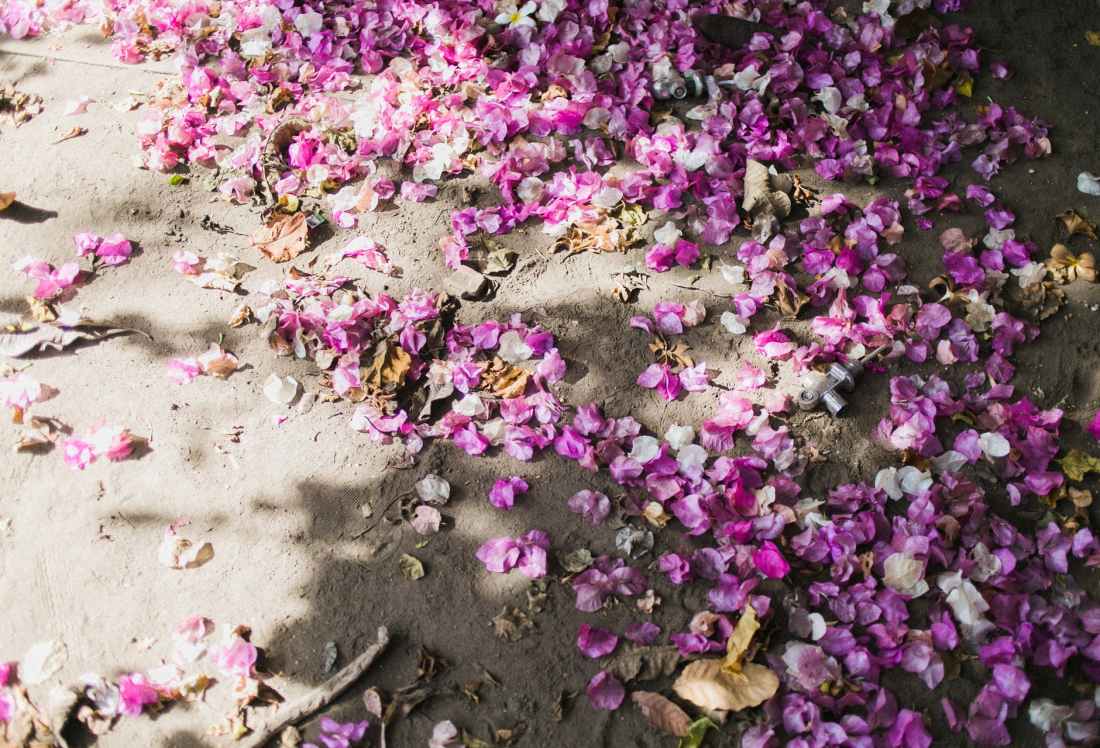
P.P.S. Featured photo is of cherry blossoms at the University of Washington in 2022, taken by me

Past Her Prime: Poem Number 9

For the first poem for March’s “women only” theme, I chose this poem, one of the earliest by a female author (after Empress Jitō, poem 2), but also one of the most famous:

JapaneseRomanizationTranslation
花の色はHana no iro waThe color of flowers
うつりにけりなUtsuri ni keri nahas faded indeed
いたらにItazura niin vain
わが身世にふるWaga mi yo ni furuhave I passed through
the world
ながめせしまにNagame seshi ma niwhile gazing at the
falling rains.
Translation by Dr Joshua Mostow

The author, Ono no Komachi (小野小町, dates unknown), is one of the most celebrated women of Japanese antiquity for both her reputed beauty and her poetry. She is one of the original Six Immortals of Poetry and the later Thirty-Six Immortals, and was said to have had relationships with various men, including Henjō (poem 12), and Fun’ya Yasuhide (poem 22) among others.

Reading this poem is something of an intimate look at the fear many women (and men, see poem 96) face then as much as now: the fear of getting old. For someone who was beautiful as Ono no Komachi, the loss may have been even more distressing.

Mostow describes this poem featured in the Hyakunin Isshu as a “technical tour-de-force”: the third line, meaning “in vain”, could technically modify either the previous line, or the one after, or both. Also, the poem uses word-play around furu which could mean to either “fall (as in rain)” or “to pass time”, while nagame could mean both “to gaze lost in thought” or “long rains” (長雨, naga-ame as Mostow explains). Further, this poem has been the object of much debate because of all the possible ways to interpret it, and is one of the most iconic in the anthology both for its technical prowess, but also it’s poignant message.

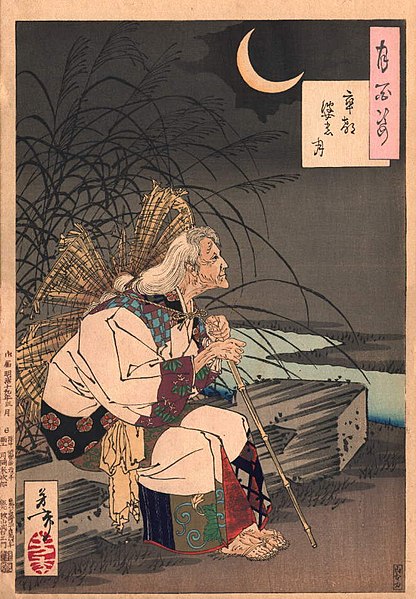
There are many legends that circulated in medieval Japan about Ono no Komachi’s good looks and her cruelty to men. In one famous story, she promised to love a certain suitor if he visited her 100 nights in a row. He completed 99 visits, but failed one night to visit her, and was so distraught that he fell ill and died. Ono no Komachi’s life and legends, including her decline, grew to become the subject of many Nō plays and art. Even 19th century woodblock prints depicted Ono no Komachi in her twilight years:

Yoshitoshi, One Hundred Aspects of the Moon, woodblock print #25, Public domain, via Wikimedia Commons

However, if you look at her other poems, mostly found in the Imperial anthology, the Kokin Wakashū, you can see she was more caring and sensitive than legend implies:

JapaneseRomanizationTranslation
思ひつつOmoitsutsuTormented by love
寝ればや人のNurebaya hito noI slept and saw him near me —
見えつらむMietsuranhad I known my love’s
夢と知りせばYume to shirisebavisit was but a dream I
覚めざらましをSamezaramashi oshould never have awakened.
Poem 552 in the Kokin Wakashū, translation by Laurel Rasplica Rodd and Mary Catherine Henkenius in Kokinshu: A Collection of Poems Ancient and Modern.

and:

JapaneseRomanizationTranslation
わびぬればWabinurebaI have sunk to the
身をうき草のMi o ukikusa nobottom and like the rootless
根を絶えてNe o taeteshifting water weeds
誘ふ水あらばSasou mizu arabashould the currents summon me
いなんとぞ思ふInan to zo omouI too would drift away
Poem 938 in the Kokin Wakashū, translation by Laurel Rasplica Rodd and Mary Catherine Henkenius in Kokinshu: A Collection of Poems Ancient and Modern.

So, Ono no Komachi wasn’t just a pretty face past her prime, she was a smart woman with a sharp wit, and a more sensitive side as well.

Winter Isolation: Poem Number 28

Winter’s always a quiet, lonely time (just ask Sei Shonagon):

JapaneseRomanizationTranslation
山里はYamazato waIn the mountain village,
冬ぞさびしさFuyu zo sabishisait is in winter that my loneliness
まさりけるMasari-keruincreases most,
人めも草もHitome mo kusa mowhen I think how both have dried up,
かれぬと思Karenu to omoebathe grasses and people’s visits.
Translation by Dr Joshua Mostow

According to Mostow, this poem was composed in answer to the question of whether Fall or Winter was the lonelier season. Obviously the author, Minamoto no Muneyuki Ason (源宗于朝臣, ? – 939), “Sir Minamoto no Muneyuki”, favored winter. Minamoto no Muneyuki was the grandson of Emperor Kōkō (poem 15) and had a large portfolio of poems published in official anthologies, and earned himself a place among the Thirty Six Immortals of Poetry as well.

To me at least, the poem reminds me also of nobleman from the Heian Court who were required to do at least one tour of duty in remote provinces as a provincial governor for 4 years. The more remote the province, the more menial and degrading the task. Very well-to-do men could usually get themselves out of this obligation but most middle and lower ranking officials could not. Being cut off from the Heian Court was often a lonely affair as evinced in the writings of men like Sugawara no Michizane and others so imagine the author was also conveying this familiar sense of the time of loneliness officials stuck in a remote mountain village away from the Court in winter and from friends.

Feeling Like Late Fall: Poem Number 29

November marks the last throes of Fall, and so with the recent cold here in the Pacific Northwest, I thought this poem seemed really fitting:

JapaneseRomanizationTranslation
心あてにKokoroate niMust it be by chance,
らばやOrabaya oranif I am to pluck one,
that I pluck it? —
初霜のHatsushimo nowhite chrysanthemums
おきまどせるOki madowaseruon which the first frost
白菊の花Shiragiku no hanalies bewilderingly.
Translation by Dr Joshua Mostow

According to my new book, Ōshikōchi no Mitsuné (凡河内躬恒, dates unknown) was a middling bureaucrat in the Imperial Court, serving in provinces such as Tanba, Izumi, and Awaji, but never reaching beyond the sixth rank in the Court hierarchy. Nobility usually were fifth rank or higher by default so he hit the “glass ceiling” so to speak.

On the other hand, Mitsune was very prodigious poet and his works appear in many later anthologies in Japanese history, and is also one of the compilers of the famous Kokinshū anthology, a prestigious honor. Not surprisingly he is among the Thirty-Six Immortals of Poetry too.

Professor Mostow notes that this poem is subject to many different interpretations ranging from simple word-repetition, to rhetorical questions or the speaker’s mental debate.

In any case, the imagery of white frost on white chrysanthemum’s, and how it’s hard to distinguish one from the other, is in large part why this poem is so highly prized in antiquity, and made it into the Hyakunin Isshu anthology. However, the 19th century poet Masaoka Shiki criticized the imagery as unrealistic. But my new book points out that that probably wasn’t the point. Mitsuné was trying to be surreal in his imagery and that the poem executes this brilliantly.

But you decide: is the imagery of first frost on a white chrysanthemum too much? Or is it brilliant imagery?

P.S. Since antiquity, September 9th has been the Day of the Chrysanthemum in Japan, mirroring a similar festival in China.

Come See the Fall Leaves: Poem Number 26

Now that fall is full swing this poem seemed fitting:

JapaneseRomanizationTranslation
倉山OgurayamaO autumn leaves
みねのもみMine no mojijibaon the peak of Ogura Hill,
心あらばKokoro arabaif you have a heart,
今ひとたびのIma hitotabi noI would that you would wait
みゆき待たなMiyuki matananfor one more royal progress.
Translation by Dr Joshua Mostow

The author of this poem is Teishinkō (貞信公, 880-949), also known as Fujiwara no Tadahira, a scion of the increasingly powerful Fujiwara clan. The name “Teishinkō” is his posthumous name. The Fujiwara clan’s descendants grew increasingly powerful and ultimately monopolized the government during the Heian Period through intermarriage with the Imperial Family. By this point, you also may have noticed the increasing number of poets in the Hyakunin Isshu with the surname Fujiwara, gradually crowding out other noble families within the Imperial Court.

As Mostow notes, this poem seems to describe an excursion to the Ōi River by retired emperor (上皇, jōkō), Emperor Uda, who comments that his son the reigning emperor (天皇, tennō), Emperor Daigo, should visit too. Hence the author is beseeching the fall leaves to wait for Daigo’s arrival. This visit seems to have led to a seasonal tradition of visiting the Ōi River yearly by the Imperial Family. Further, compare this poem to a similar fall (poem 24), when Uda was still the reigning emperor.

Also, it should be noted that Ogura Mountain is none other than the place where the Hyakunin Isshu itself was compiled.

Side note: there are in fact two Oi Rivers in Japan, one near Kyoto the old capitol, and another in modern Shizuoka Prefecture. Due to location of the Imperial Court, the Emperor and his retinue almost certain visited the near Kyoto. It is, as the photo above helps illustrate, a very scenic and venerable of Japan. It is also mentioned in the Pillow Book by Sei Shonagon (poem 62) in note 59 under “Rivers”.

One other note: the term miyuki in the poem refers to an imperial outing. Such an outing was, naturally, an important occasion and so it has its own term in Japanese. According to the Hyakunin Isshu Daijiten, the “kanji” Chinese characters for miyuki differ if a retired emperor has an outing (御幸), or the current reigning emperor has an outing (行幸).

P.S. Featured photo is the Togetsukyo Bridge near the Ōi River which passes through the Arashiyama district of Kyoto. Photo taken by me in August of 2024.

Poetry as Wordplay: Poem Number 22

The twenty-second poem in the Hyakunin Isshu is a brilliant example of word-play:

JapaneseRomanizationTranslation
ふくからにFuku kara niAs soon as it blows,
秋の草木のAki no kusaki nothe autumn trees and grasses
るればShiorurebadroop, and this must be why,
むべ山風をMube yama kaze oquite rightly, the
mountain wind
あらしといArashi to iuranis called “the ravager.”
Translation by Dr Joshua Mostow

This poem was composed by Fun’ya no Yasuhidé (文屋康秀, ? – 879?), but according to Mostow, it is known that he lived around the time Narihira (poem 17) and Sosei (poem 21). He is also one of the Six Immortals of Poetry. My new book points out that he was upper-sixth rank in the Imperial bureaucracy, a middling rank, so he was a somewhat minor official. And yet as a poet, he achieved great fame.

Yasuhide was also known for carrying on a tryst with Ono no Komachi (poem 9) and invited her to come away with on a retreat to Mikawa Province. She reportedly accepted the offer but other details of the story are unclear.

In any case, from the English translation, it’s hard to see what is so remarkable about this poem, until you look at the last two lines.

The fourth line talks about mountains and wind , but the fifth line mentions the word arashi (あらし) which means “storm” and whose kanji (chinese character) is composed of both mountain and wind . It makes even more sense when you see it on karuta card (yomifuda) for this poem:

Circled in blue is the word arashi (あらし) using hiragana script, but in red are the Chinese characters for mountain and wind. When looked at closely, they also look like the Chinese character for arashi (嵐).

According to the Hyakunin Isshu Daijiten, this poetic method, called moji-asobi (文字遊び) is not limited to this poem, or even Japanese poetry. It appears to be a poetic method employed originally in China, and adopted by early Japanese poets. For example, in the first Imperial anthology, the Kokin Wakashu, you can find this poem by Ki no Tomonori (poem 33 in the Hyakunin Isshu):

JapaneseRomanizationTranslation
雪降ればYuki furebaBecause the snow fell
木毎に花ぞKigoto ni hana zoWhite “blossoms”, one by one,
吹きにけるFukinikeruSprout on the tree.
いづれを梅とIzure wo ume toHow am I to tell the blossoms from the snow
わきて折らましWakite oramashiWithout snapping them off?
Rough translation by me, based on Hyakunin Isshu Daijiten

Here, the word for plums (as well as plum blossoms), umé 梅, is made up of the Chinese characters 木 and 毎 which happen to appear on the second line of the poem.

Pretty clever, really.

In any case, the Hyakunin Isshu Daijiten and Professor Mostow both point out that the word arashi also has a double-meaning. The basic meaning is “storm”, but it is also the noun-form of the verb arasu meaning to ravage, hence the translation above: arashi (荒らし).

Amazing what people could do with a few lines of verse and some Chinese characters. It’s no surprise that the author, Fun’ya no Yasuhide, was counted among the original Six Immortals of Poetry and later the Thirty-Six Immortals.

P.S. Kind of been a while, good to be back. 🙂

P.P.S. Featured photo is a different “Arashi“, photo by Japanese Station, CC BY 3.0, via Wikimedia Commons

A Thousand Swift Swords: Poem Number 17

One of the most famous and recognizable poems in the Hyakunin Isshu is poem 17:

JapaneseRomanizationTranslation
千早ぶるChihayaburuUnheard of
神代もきかずKamiyo mo kikazueven in the legendary age
龍田がわTatsuta-gawaof the awesome gods:
からくれなKarakurenai niTatsuta River in scarlet
みずくくるとはMizu kukuru to waand the water flowing under it.
Translation by Dr Joshua Mostow

The poet, Ariwara no Narihara Ason (在原業平朝臣, 825 – 990) or “Sir Ariwara no Narihara”, was the closest thing to a poetic genius during his time, and this poem is a prime example. Originally published in the Imperial anthology, the Kokin Wakashū, as poem number 294, it is considered one of the most iconic of the one-hundred Hyakunin Isshu poems.

Narihara is also credited for writing what is considered the greatest Waka poem on cherry blossoms (桜, sakura) ever composed:

JapaneseRomanizationTranslation
世の中にYo no naka niIf in all the world
絶えて桜のTaete sakura nothere were of cherry blossoms
なかりせばKanarisebano trace anywhere
春の心はHaru no kokoro waah, how truly peaceful then
のどけからましNodokekaramashispring would be for everyone!
Translation by Dr Josha Mostow and Dr Royall Tyler from the Ise Stories, the poem is also number 53 in the Kokin Wakashū.

Not surprisingly, Narihira was thus considered one of the Six Immortals of Poetry.

Returning to this poem, there is a lot to unpack. The imagery of red, autumn leaves flowing along the river provides a very memorable contrast. The Tatsuta-gawa River can be found in modern-day Nara Prefecture, and is a scenic, gentle flowing river near the town of Ikaruka. I’d love to see it someday. I cover more about the Tatsuta-gawa River and iconic Mt Mimuro in poem 69, but several poems in the Kokin Wakashū anthology also refer to fall leaves floating on it.

Also, it should be noted that the fourth line is an example of a traditional Japanese color word.

Lastly, the opening line of this poem, chihayaburu, is a prime example of “pillow words” in Japanese poetry. It literally means something like “a thousand swift swords”, but really is an honorific epithet when referring to the gods, similar to how Homer used to use special epithets for each of the Olympian gods. Nevertheless, it’s a famous line, and can be found in Waka poetry written even in modern times, and is also the title of the popular manga exploring the Hyakunin Isshu card game.

If there is one poem worth learning in all the Hyakunin Isshu, I would argue, it is this one.